
The road to this paper ran through the Soddy preprint. After it, I began normalizing the fermion spectrum to the lepton-sum scale μ⋆, a once-unthinkable cross-sector comparison that, having survived its first null tests, begged the obvious question: if a lepton-derived scale lands on a quark mass, what else does it land on? Who wouldn't try? The result looked at first like more complex mathematics, but complex in a specific way: everything arrived in mirrors.
The working goal had not changed since the solver that started all of this: the most compact formula possible for the building blocks of most of the matter we interact with day to day, the u, d, and s quarks. Partway there I realized that both targets were achievable at once: a compact closed form for the light-quark masses, and a single iteration function that returns them.
The paper's actual content is a unification of descriptions. The literature contained five different formulations of the charged-lepton constraint, all of them equivalent; the published version keeps the three I judged most important, the Fourier-mode constraint on Shulga's compact cycle, Kocik's Descartes curvature condition, and the Soddy completion, and shows they are one algebraic object related by exact rearrangement, with no approximations anywhere in the chain.
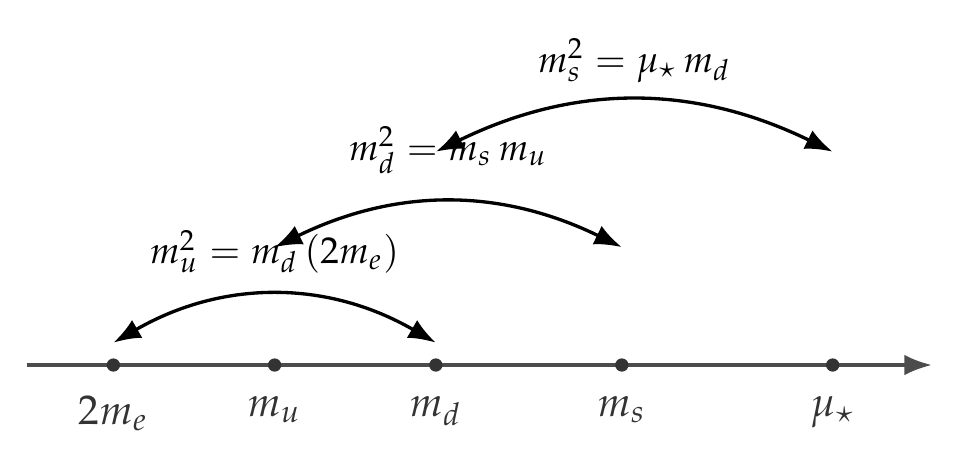
And what fell out of that algebra was GST itself. The light-quark cascade gives md/ms = 5/2 − √6, and the leading Gatto–Sartori–Tonin relation turns it into √(md/ms) = 0.22474…, against the measured |Vus| = 0.22503 ± 0.00068 (0.4σ). Stumbling into one of the most famous relations in particle physics was reassuring rather than triumphant: GST is hardened phenomenology, sixty years of infrastructure across every corner of HEP is built around it, and arriving at it from an independent direction was evidence of building in the right direction. The paper is careful about scope: a down-sector seed, the up-sector phase correction explicitly deferred, failure modes listed.
The cascade is best seen as mirrors in the mathematical sense: each rung is the geometric mean of its neighbours, and the chain closes back into the leptons it started from.
The biggest open questions are the endpoints. Why 2me? And why Σ√mℓ, for that matter? I have about sixteen mutually conflicting speculative answers, and none of them feels right, so the paper attempts none: the failure modes are stated, and the correspondence is left for future lattice QCD+QED determinations of md/ms to sharpen or kill.